
📖 Background #
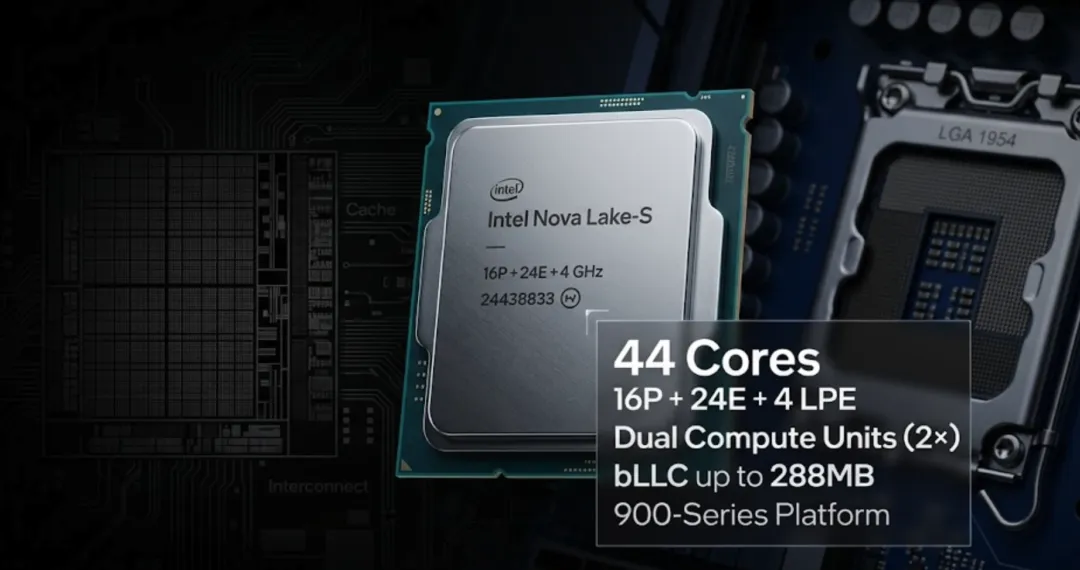
Intel is reportedly revising the configuration of its upcoming Nova Lake-S desktop processors, replacing the originally planned 42-core flagship with a 44-core design.
While the dual-tile (dual compute unit) structure remains unchanged, the internal layout has been adjusted:
- From 14P + 24E cores
- To 16P + 24E cores + 4 LPE cores
This change is not simply about increasing core count—it reflects a deeper optimization in architectural balance and system efficiency.
⚙️ Architectural Symmetry: 14P vs. 16P #
The primary driver behind this shift is symmetry in a dual-tile design.
The Problem with 42 Cores #
A 14P-core configuration results in:
- 7 P-cores per tile
- Asymmetrical distribution across compute units
This creates challenges such as:
- Increased scheduling complexity
- Irregular latency between tiles
- More difficult signal routing and load balancing
The Advantage of 44 Cores #
By moving to 16 P-cores, Intel achieves:
- 8 P-cores per tile
- A clean 8P + 12E layout per compute unit
This symmetry enables:
- More predictable scheduling behavior
- Improved efficiency for the Thread Director
- Reduced inter-tile latency variance
In short, the move to 44 cores is about consistency and scalability, not just raw core count.
🧠 bLLC: A New Cache Layer #
A key innovation in Nova Lake-S is the introduction of bLLC (block Last Level Cache).
Unlike traditional L3 cache, bLLC functions as a large shared buffer layer across compute units, designed to:
- Reduce memory access pressure
- Improve data locality across tiles
- Mitigate inter-die communication overhead
bLLC Configuration #
- Dual Compute Unit: 288MB bLLC
- Single Compute Unit: 144MB bLLC
As core counts scale upward, memory bandwidth becomes a limiting factor. bLLC helps prevent performance degradation by ensuring that frequently accessed data remains closer to the cores.
📊 SKU Segmentation Strategy #
Nova Lake-S introduces a more structured product hierarchy based on compute unit count and cache capacity.
Expected SKU Tiers #
-
Flagship Dual-Tile
- 2×(8P + 16E) + 4 LPE
- 288MB bLLC
-
High-End Dual-Tile
- 2×(8P + 12E) + 4 LPE
- 288MB bLLC
-
Mid-Range Single-Tile
- (8P + 16E) + 4 LPE
- 144MB bLLC
-
Entry-Level Single-Tile
- (8P + 12E) + 4 LPE
- 144MB bLLC
Notably, cache capacity becomes a primary differentiator, rather than just clock speeds or core counts. This signals a shift toward data-centric performance scaling.
🔌 Platform and Power Considerations #
Nova Lake-S also introduces a new platform foundation:
- Socket: LGA 1954
- Chipset: 900-series
Intel aims to extend this platform across multiple generations, offering greater ecosystem stability.
Key Platform Characteristics #
- Up to 36 lanes of PCIe 5.0
- Additional 16 lanes of PCIe 4.0
- Total cache capacity reaching ~320MB (including L2 + bLLC)
Power Implications #
The increased scale comes with significant power demands:
- Dual-tile configurations may approach ~700W peak power
- Requires advanced VRM design
- Necessitates high-end cooling solutions
This positions Nova Lake-S firmly in the ultra-high-performance desktop category.
🔍 Why the Core Increase Matters #
The shift from 42 to 44 cores is not about marginal gains in thread count.
Instead, it delivers:
- Cleaner architectural symmetry
- More efficient scheduling behavior
- Better scaling across multiple compute tiles
Combined with bLLC, the design ensures that performance scales more effectively under heavy multi-threaded workloads.
🧾 Summary #
- Core Change: 42-core → 44-core for symmetrical dual-tile design
- Architecture: 16P + 24E + 4 LPE cores
- Key Innovation: bLLC cache (up to 288MB)
- Benefit: Reduced latency and improved scalability
- Platform: LGA 1954 with next-gen connectivity
- Trade-off: Extremely high power requirements
Nova Lake-S highlights a critical shift in CPU design philosophy: balanced architecture and data movement efficiency now matter as much as raw core count. The move to 44 cores reflects Intel’s focus on building scalable, predictable performance in increasingly complex multi-die processors.