
40 Years of FPGA: From Xilinx Logic to Edge AI
Four decades after Xilinx introduced the first commercially available field-programmable gate array, FPGA technology has evolved from configurable logic arrays into highly integrated computing platforms capable of accelerating AI, processing high-speed data, and supporting real-time edge applications.
What began as an effort to make hardware design more flexible has become a major semiconductor technology spanning aerospace, automotive, communications, industrial automation, robotics, and artificial intelligence.
As AMD marks the 40th anniversary of the first Xilinx FPGA, the company’s history provides a useful perspective on why reconfigurable computing has remained relevant despite the emergence of GPUs, ASICs, and increasingly specialized AI accelerators.
🕰️ The Beginning: Xilinx and the First FPGA #
The FPGA story began in 1985 when Xilinx introduced its first commercially available field-programmable gate array.
The company’s origins date back to 1984, when Ross Freeman, Bernie Vonderschmitt, and James Barnett left Zilog to pursue programmable silicon. With approximately $862,000 in early backing from Kleiner Perkins, the team developed a fundamentally different approach to hardware design.
Rather than requiring customers to commit to fixed-function silicon or expensive custom gate arrays, Xilinx enabled engineers to configure programmable logic after purchasing a standard device.
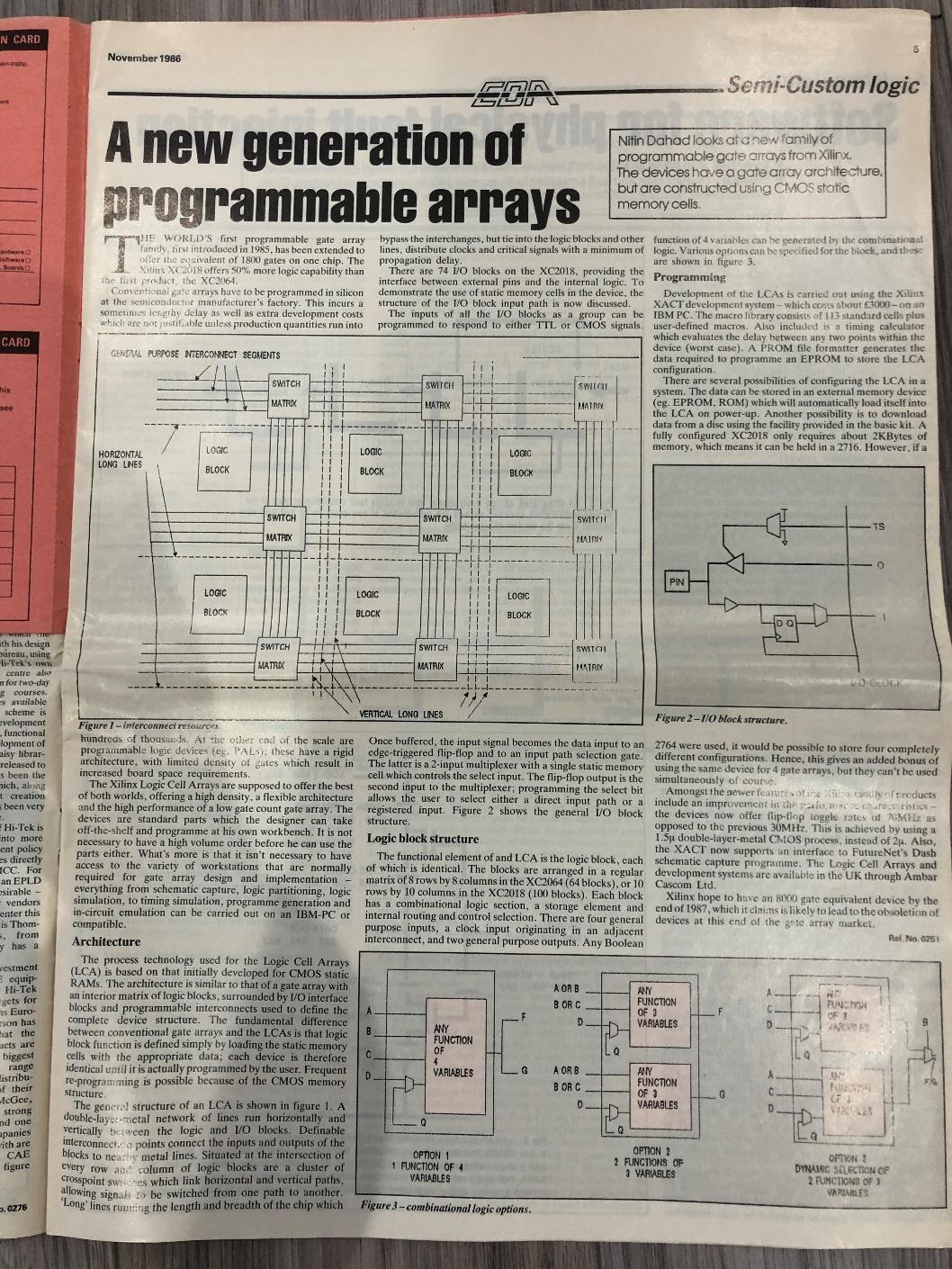
In 1986, Xilinx introduced the XC2018, featuring approximately 1,800 gates. The device helped demonstrate how configurable CMOS logic could give hardware designers a faster and more economical alternative to traditional fixed logic implementations.
The technology ultimately helped establish an industry that would grow into a multibillion-dollar market.
🧩 Programmable Logic Democratized Hardware Design #
Early FPGAs addressed a major limitation in digital hardware development: customization traditionally required specialized manufacturing processes, significant upfront costs, and long production cycles.
Xilinx’s Logic Cell Array architecture changed that model.
Designers could configure commercially available devices rather than ordering custom silicon for every application. This reduced barriers to experimentation and allowed hardware designs to evolve after deployment.
An account published in EDA Magazine in 1986 captured the significance of the approach, emphasizing the combination of programmable architecture, relatively high density, and accessible PC-based development.
The fundamental proposition remains relevant today: hardware can be customized without requiring a new chip for every design iteration.
📈 Three Billion Devices and a Broader Computing Platform #
Four decades later, AMD reports that more than 3 billion Xilinx FPGAs and adaptive SoCs have shipped to more than 7,000 customers.
AMD acquired Xilinx in 2022 in a transaction valued at approximately $49 billion, bringing FPGA and adaptive-computing technology into a broader portfolio spanning CPUs, GPUs, embedded processors, and accelerators.
The scale of the installed base demonstrates how far FPGA technology has expanded beyond its original role as programmable logic.
Modern FPGA-based platforms can integrate processor cores, programmable logic, AI engines, high-speed networking interfaces, memory subsystems, and specialized acceleration resources within a single heterogeneous architecture.
🤖 From CLBs and LUTs to AI Engines #
The evolution of FPGA architecture has been substantial.
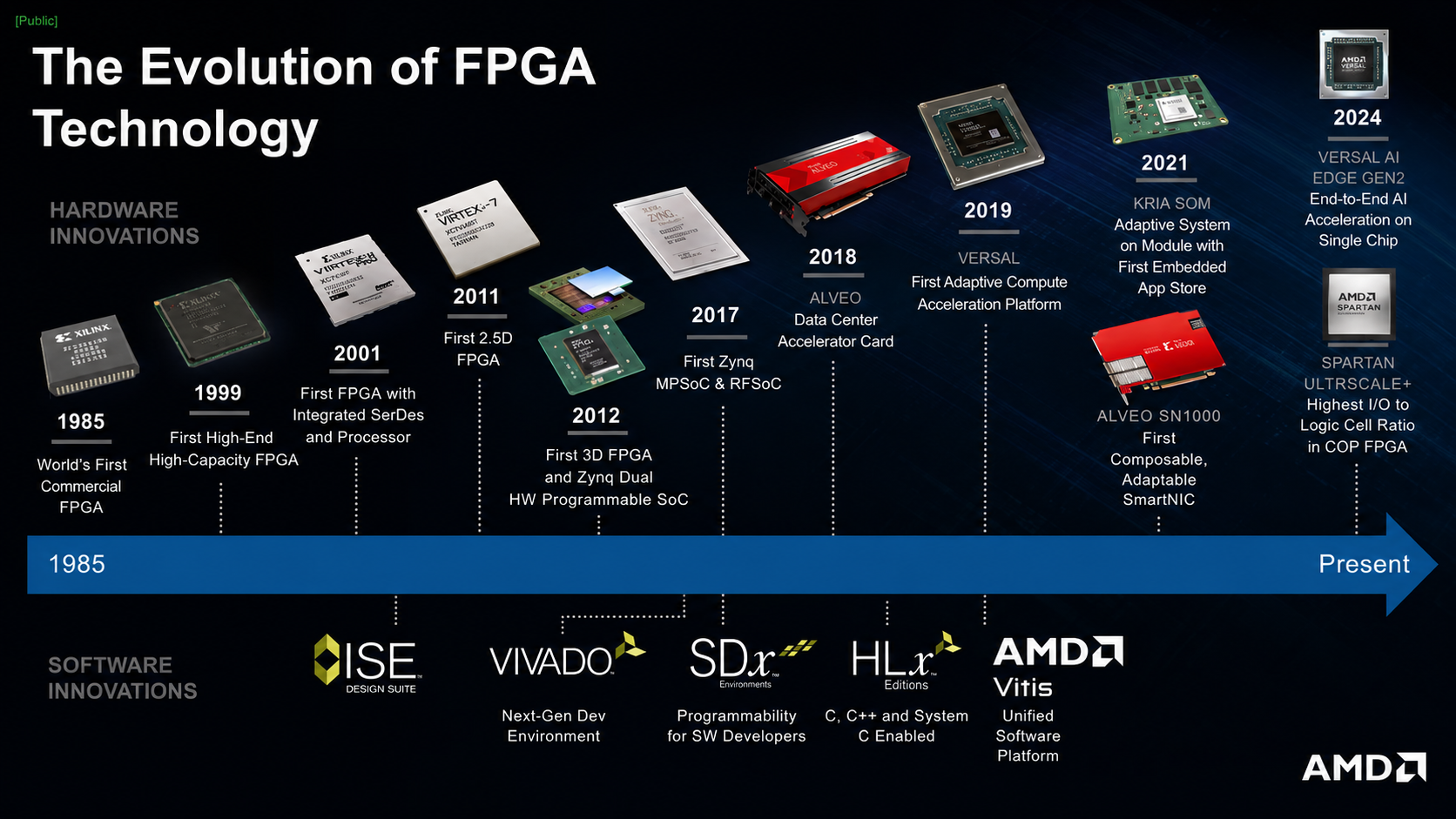
Kirk Saban, AMD’s corporate vice president for adaptive and embedded computing, describes the progression from basic configurable logic blocks and lookup tables to devices incorporating dedicated AI engines and extremely high-speed SerDes interfaces.
This evolution reflects a broader transformation in the role of programmable logic.
Modern FPGA and adaptive SoC platforms are increasingly designed to execute complete workloads rather than simply implement isolated digital circuits. They can combine general-purpose processing with deterministic hardware acceleration and specialized data paths.
That combination is particularly useful when workloads require predictable latency rather than maximum theoretical throughput alone.
⚙️ Zynq Connected Programmable Logic With Software #
One of the most important milestones in Xilinx’s history was the introduction of the Zynq platform around 2010.
Zynq integrated Arm processor cores with programmable logic, creating a heterogeneous computing platform that could combine software and customized hardware within the same device.
This represented a major shift in how engineers approached FPGA development.
Instead of designing primarily around hardware description languages such as Verilog, developers could build complete application stacks in which conventional software executed on processor cores while programmable logic handled deterministic or computationally intensive functions.
Software and Hardware on One Platform #
The Zynq architecture helped bridge the traditionally separate worlds of embedded software and FPGA development.
A developer could run operating systems and application code on the Arm subsystem while implementing specialized accelerators, signal-processing pipelines, and custom interfaces in programmable logic.
This model proved particularly attractive for robotics, automotive systems, industrial equipment, and other applications where real-time processing and hardware flexibility are both important.
The Zynq family subsequently developed into a major business for Xilinx and became an important foundation for AMD’s adaptive-computing portfolio.
🧱 2.5D Packaging and Chiplet Integration #
FPGA evolution has not been limited to programmable logic architecture.
Xilinx also became an early adopter of advanced packaging approaches, including 2.5D integration and chiplet-based designs using technologies such as TSMC’s CoWoS packaging platform.
Advanced packaging allows multiple silicon components to operate as a heterogeneous system rather than forcing every function onto a single monolithic die.
For FPGAs, this approach can provide greater capacity and flexibility while allowing different portions of the device to be optimized independently.
The same principles have since become increasingly important throughout the semiconductor industry, particularly in GPUs and AI accelerators where integrating large amounts of compute, memory, and high-speed interconnect on a single package has become increasingly difficult using conventional monolithic designs.
🔄 Adaptability Remains the Core FPGA Advantage #
The rise of GPUs and ASICs has not eliminated the need for FPGAs.
Instead, each architecture occupies a different position in the computing spectrum.
ASICs can provide exceptional efficiency and performance when a workload is sufficiently stable and production volume justifies the substantial development cost. GPUs offer massive parallel throughput and have become dominant in many AI training and inference workloads.
FPGAs occupy a different position by providing hardware-level customization without permanently fixing the architecture in silicon.
That distinction becomes particularly valuable when standards, algorithms, interfaces, or workloads are expected to change.
Where Reconfigurability Matters #
FPGAs remain attractive in applications including:
- Defense and aerospace systems
- Industrial automation
- Telecommunications and networking
- Automotive electronics
- Robotics
- Real-time signal processing
- Edge AI
- Safety-critical computing
In these environments, the ability to update hardware functionality can be more valuable than maximizing peak throughput on a fixed workload.
🔗 AMD Expands the Adaptive Computing Ecosystem #
The acquisition of Xilinx gave AMD a broader computing portfolio that extends from embedded systems to data center acceleration.
FPGAs and adaptive SoCs now sit alongside AMD’s x86 CPUs, Radeon GPUs, and data center accelerators, creating multiple paths for heterogeneous computing.
AMD has also continued supporting multiple processor architectures within its adaptive-computing strategy. Arm and RISC-V technologies can complement programmable logic depending on application requirements.
The MicroBlaze V soft processor is one example of this flexibility, bringing a RISC-V-based processor architecture into programmable logic environments.
This broader ecosystem allows developers to select different combinations of general-purpose processing, programmable acceleration, and specialized compute resources rather than relying on a single processor architecture.
🧠 Edge AI Could Define the Next FPGA Era #
Edge AI is emerging as one of the strongest use cases for adaptive computing.
Many edge systems must process sensor, vision, and AI workloads locally while meeting strict latency, power, reliability, and safety requirements. Sending every workload to a remote data center is often impractical because of network latency, bandwidth constraints, privacy requirements, or operational limitations.
FPGAs are well suited to these scenarios because developers can construct customized data paths that process information deterministically and in parallel.
Applications can combine sensor fusion, image processing, inference, control logic, and communications within a single adaptive platform.
From Autonomous Vehicles to Agriculture #
Potential applications range from autonomous vehicles and industrial robotics to agricultural systems and defense platforms.
In safety-critical environments, local processing can enable systems to react to sensor information without depending entirely on cloud infrastructure.
The combination of programmable logic and AI acceleration is therefore not simply about increasing inference throughput. It is about building systems that can respond predictably to real-world inputs under constrained power, latency, and connectivity conditions.
🦾 Humanoid Robotics Creates Another FPGA Opportunity #
Humanoid robotics represents another emerging application for adaptive computing.
Advanced robots must simultaneously process cameras, depth sensors, force sensors, motor feedback, communications, and AI models while maintaining tight real-time control loops.
That creates a heterogeneous workload that can benefit from a combination of CPU-based software, AI acceleration, and deterministic hardware processing.
Humanoid robots intended for hazardous environments could further increase demand for localized compute architectures capable of processing sensor information and control decisions with minimal latency.
The technology remains at an early stage, but the convergence of robotics, edge AI, and adaptive computing creates a natural opportunity for FPGA-based platforms.
🌐 Four Decades of Reconfigurable Computing #
Forty years after Xilinx introduced its first FPGA, the underlying concept remains remarkably durable.
The technology has progressed from configurable logic cells and lookup tables to adaptive SoCs, integrated AI engines, high-speed SerDes, chiplet architectures, and heterogeneous computing platforms.
The reason for that longevity is straightforward: computing requirements change.
A fixed-function architecture can be extremely efficient when workloads are stable, but reconfigurable hardware provides a valuable middle ground between software flexibility and ASIC-level hardware acceleration.
As AI moves increasingly toward the edge, robotics becomes more autonomous, and real-time processing requirements continue to expand, that adaptability could become even more important.
The FPGA’s next chapter may therefore look very different from its first 40 years—but its defining characteristic remains the same: the ability to change the hardware to match the workload.